Lesson 1: The history of language in Jamaica
Taino: The first inhabitants
To fully explore the history of language in Jamaica, one would have to go back to the 9th century, around the time when the earliest evidence of the Taino Indians was found on the island. One theory of how the Tainos came to the Caribbean, an ultimately to Jamaica, is that they migrated from the Amazon Basin in South America. Their path moved eastward into Guyana, then Venezuela, into Trinidad, and then moving along the Lesser Antilles until they arrived at the Bahamian archipelago, Cuba, and of course Jamaica. The Tainos spoke an Arawakan language—and this would’ve been the very first language in Jamaica.Much of what we know about the language and culture of the Tainos come from observing the lives of modern day Tainos and other groups of Amerindians—such as the Lokono—who use an Arawakan language.
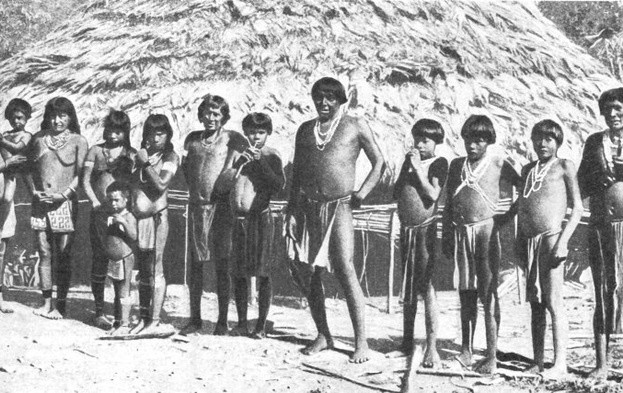
Taino Indians in Puerto Rico. Source: Arawak: Indigenous Caribbeans
Modern day Tainos have a small but active community in Puerto Rico, but sadly, no such community of Tainos exist in Jamaica today. The Tainos who lived in Jamaica would’ve existed there for several hundred years before Columbus stumbled upon them in 1492. That of course marked the beginning of the end for the Taino civilization that existed on the island.Not long after the Spanish came to Jamaica, their system of exploitation began. Whether it was murder, communicable diseases, or overwork, the Taino population was decimated in a few years. By the time the Spanish started to supplement their slave system with labour from enslaved Africans, not much was left of the Taino civilization which existed prior to their arrival. The few that did manage to escape the coastal slave plantations, would’ve sought out refuge in the hilly interior of the island along with escaped Africans and established Maroon communities in several areas across the island. Given the relatively small number of Tainos which would have been around at that time, their heritage would be absorbed by the dominant African culture through intermarriage. Before long, all that remained of the Taino civilization would’ve been artefacts such as tools and household items, and a few words from their language—chief among those words was “Xaymaca” the original name for Jamaica.
What happened to the Taino?
The first language in Jamaica was likely the Arawakan language spoken by the Taino Indians. But, contrary to what some believe, this language is not a contributing language to modern Jamaican Creole. How would this be? The language of the Tainos was in Jamaica hundreds of years before there was anything called Jamaican Creole/Patois, so where did it disappear to?The answer to this has to do with the rapidly dwindling Taino population after the Spanish arrival. Once the Spanish colonization began, the Tainos who didn’t die on the plantation were displaced and lived as Maroons alongside formerly enslaved Africans. In both instances—on the plantation, and in the Maroon settlement—the Tainos were in the minority. One of the realities of being in the minority, both numerically and culturally, is that the culture of the smaller group might start to gradually diminish. The Spanish certainly had no interest in adopting any aspect of Taino culture, and the early Maroons, though from different parts of West Africa, were at least united by their geographical area of origin. There was simply no survival advantage to be gained from preserving the Taino culture, and as time went by it continued to contract until it was submerged by the dominant African culture. This was a case of language death due to severely reduced number of speakers and unfavourable conditions for cultural preservation.
When did Jamaican Creole emerge?
It is not easy to pinpoint when exactly a new language starts, and it is even harder to do so when that new language emerges in a context where there are several other languages in use. Think of it like a colour-palette that has all the different colours and their various gradients; the difference between black and white, for example, is very easy to notice, but it’s harder to decide where on the gradient that black turns into white or vice versa. Where the Jamaican language is concerned, we know there was a time when there was no Jamaican Creole (before 1650s) and the know there was a time when Jamaican Creole was definitely existing (after the early 1700s), but beyond that we would have to estimate a timeframe in which the language developed. There are records from the 18th century which give an idea of how many enslaved Africans would have been living in Jamaica relative to the population of the colonizing power, but records from that time aren’t always reliable. What we can extrapolate though is that some fifty years after the colonization of Jamaican by the British, a new language started to emerge on the plantation which was spoken by the enslaved Africans. This was the early beginnings of Jamaican Creole.
The word “Creole” here is just a scientific name for a language that emerged out of a situation where two or more languages came into contact. There is a temptation to think that Jamaican Creole is a mix of all the languages that existed in Jamaica—
the Arawakan language spoken by the Tainos,
Spanish which came with Columbus,
English when the British took control in 1665,
West African languages that were brought with the enslaved Africans to the Caribbean
In reality, Jamaican Creole is a combination of numbers (3) and (4)—most of the words are from the English language, but the grammar, is West African in origin. An easy way to demonstrate this is to look at an example:
- The boys were running home
- Di bwai dem did a ron go uom
The above sentences are identical in their interpretation but capture the grammatical differences between the two languages quite clearly. As much as Jamaican Creole might be similar to English, the differences in the above indicate that the structure of the language is definitely not English. The differences can be summarized below:
- A difference in pronunciation; boy/bwai home/uom
- Pluralization in both languages is different -s/dem
- Indicating the past tense is also different were/did
- Showing that a verb is ongoing is different as well -ing/a
- It’s possible to have consecutive verbs in Jamaican Creole but not English run/ron go
And the list goes on.
The important thing to point out is that sometime shorty after British occupation a form of Jamaican Creole would have emerged on the plantation. It would be using the words of English, but the the rules for how the words were arranged to form sentences, and the ways the words were pronounced, are of West African origin.